
Wisdom Wednesday: The Wisdom of the Early Believers
Part 4 The Wisdom of God and Jacob
Submitted by Debbie’s Dad
“Then Jacob said to Joseph, “God Almighty appeared to me at Luz in the land of Canaan and blessed me, and He said to me, ‘Behold, I will make you fruitful and numerous, and I will make you a company of peoples, and will give this land to your descendants after you for an everlasting possession.’ ” (Gen. 48:3-4) NASB 95
In this series, we began with Job, Abraham, and Isaac, examining the wisdom theme throughout their lives, and now we look at Isaac’s son, Jacob. Jacob is a challenge because we see more detailed accounts in Scripture of his early stubborn foolishness than his subsequent fear of the Lord (the first principle of wisdom) in later years. Jacob’s life is covered in Genesis 25-50, the most extensive description of the life of any patriarch.
The Foolishness of Jacob
The Bible warns against our self-reliance and the foolish tendency to become cunning, crafty, and will and deceitful:
- “The wisdom of the sensible is to understand his way, But the foolishness of fools is deceit.” (Prov. 14:8)
- “He who hates disguises it with his lips, But he lays up deceit in his heart.” 26:24
- “Bread obtained by falsehood is sweet to a man, But afterward his mouth will be filled with gravel.” Prov. 20:17
- [The wicked] “His mouth is full of curses and deceit and oppression; Under his tongue is mischief and wickedness.He sits in the lurking places of the villages; In the hiding places he kills the innocent; His eyes stealthily watch for the unfortunate. He lurks in a hiding place as a lion in his lair; He lurks to catch the afflicted; He catches the afflicted when he draws him into his net.” 10:7–9
But God’s chosen family exhibited cunning and crafty behaviors to achieve their own way, rather than trusting in the Lord and behaving honestly (Table below). Of the eleven deceptions in the table, 8 are in the life of Jacob – and in his early years, Jacob is the perpetrator of the most well-known deception of his own father to steal the firstborn birthright from his older brother, Esau (Genesis 27).

Jacob’s foolish deceit, motivated by greed for the prized birthright, was aided by his own mother when he was approximately 25 years old and his father Isaac was in his 80’s and losing his eyesight. It was likely a pattern of secretive and deceptive behaviors that Jacob learned, and he was willing to cross the line from honesty-and-trust to deceit-and -self-reliance.
Jacob’s complex experiences made him a target of deception when he moved to Paddan-Aram (Gen 28), and he was deceived by Laban when he sought to give him Rachel as his wife. And then he experienced the inferred sinful behaviors within his large, challenged family (Figure below) that demonstrated the challenges of polygamous relationships, jealousy between wives and handmaidens, competition between brothers (within Jacob’s sons) jealousy over the “favored” wife (Rachel) and her son (Joseph), within-family resentment, and greed.
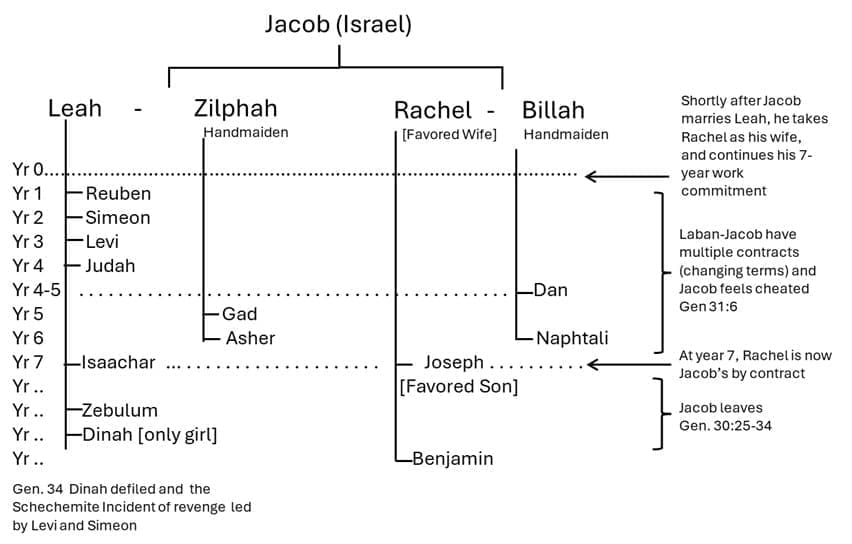 Figure 1 – The immediate family tree of Jacob (Credit- derived from a chart made by Randy Frizelle in the Men’s Bible study June 2025 Grace Bible Church, Marshall VA.)
Jacob observed many painful events within his family:
- Terror – His fear when his sons killed the men of Shechem. (Gen 34:30)
- Family pain and loss – Esau was disobedient and married two Canaanite women (26:34-35; Gen 28:8-9) and moved to Edom (Gen 36) splitting the family.
- Broken Heart – The loss of his favored son, Joseph, when his brother sold him into slavery and deceived Jacob to thinking he was killed. (Gen 37). He was distraught, “So Jacob tore his clothes, and put sackcloth on his loins and mourned for his son many days. 35 Then all his sons and all his daughters arose to comfort him, but he refused to be comforted. And he said, “Surely I will go down to Sheol in mourning for my son.” So his father wept for him.” (37:34-35) The deceiver was deceived by his own sons and it broke his heart.
- Loss and Depression – When Jacob feared the loss of his sons in Egypt, he exclaimed, “… all these things are against me” (Gen 42:36).
The Wisdom of Jacob (Israel)
In all his pain and grief, God did not give up on Jacob and met with him on multiple occasions recorded in Scripture, to reassure and instruct him:
- In Bethel Jacob had a dream and God spoke to him (Gen 28:10–220
- Watching Laban’s flocks, he had another dream and received instructions instruction (Gen 31:10–13)
- On the way to visit Esau, angels visited Jacob at Mahanaim (Gen 32:1–2)
- At Jabbok, Jacob “wrestled” with God as he feared Esau and sought to be blessed and protected. (Gen 32:24–30)
- At Shechem, God directed Jacob to return to Bethel. (Gen 35:1)
- God directed him to move to Bethel when he was about 100 years old and there, blessed him, named him Israel, and reassured him of the promise to fulfill His covenant with Abraham. (Gen 35:9–15).
- At Beersheba, God spoke to Jacob in a night vision, assuring him that he could safely go to Egypt and reaffirmed the covenant. (Gen 46:1–4)
Along the way in his complex and painful life, Jacob finally learned and wisely trusted God. Deceit and self-reliance were no more the way of his life. The writer to the Hebrews acknowledged Jacob’s dying faith: “By faith Jacob, as he was dying, blessed each of the sons of Joseph, and worshiped, leaning on the top of his staff.” (Heb 11:21–22; See Jacob’s blessing in Gen. 49)